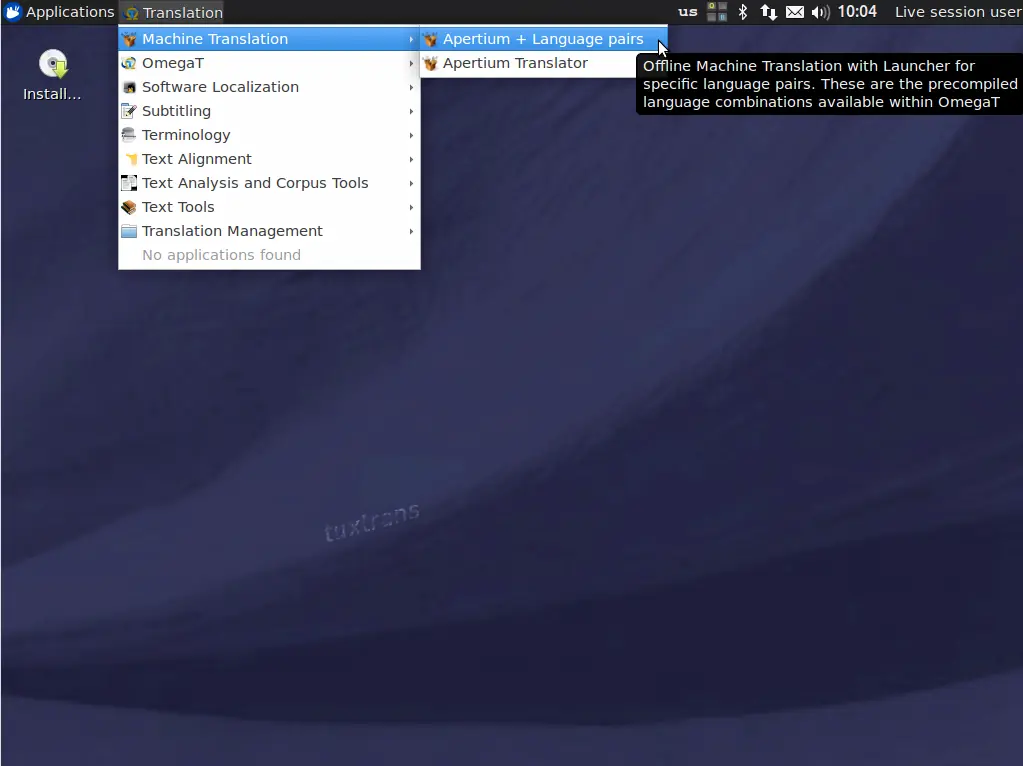
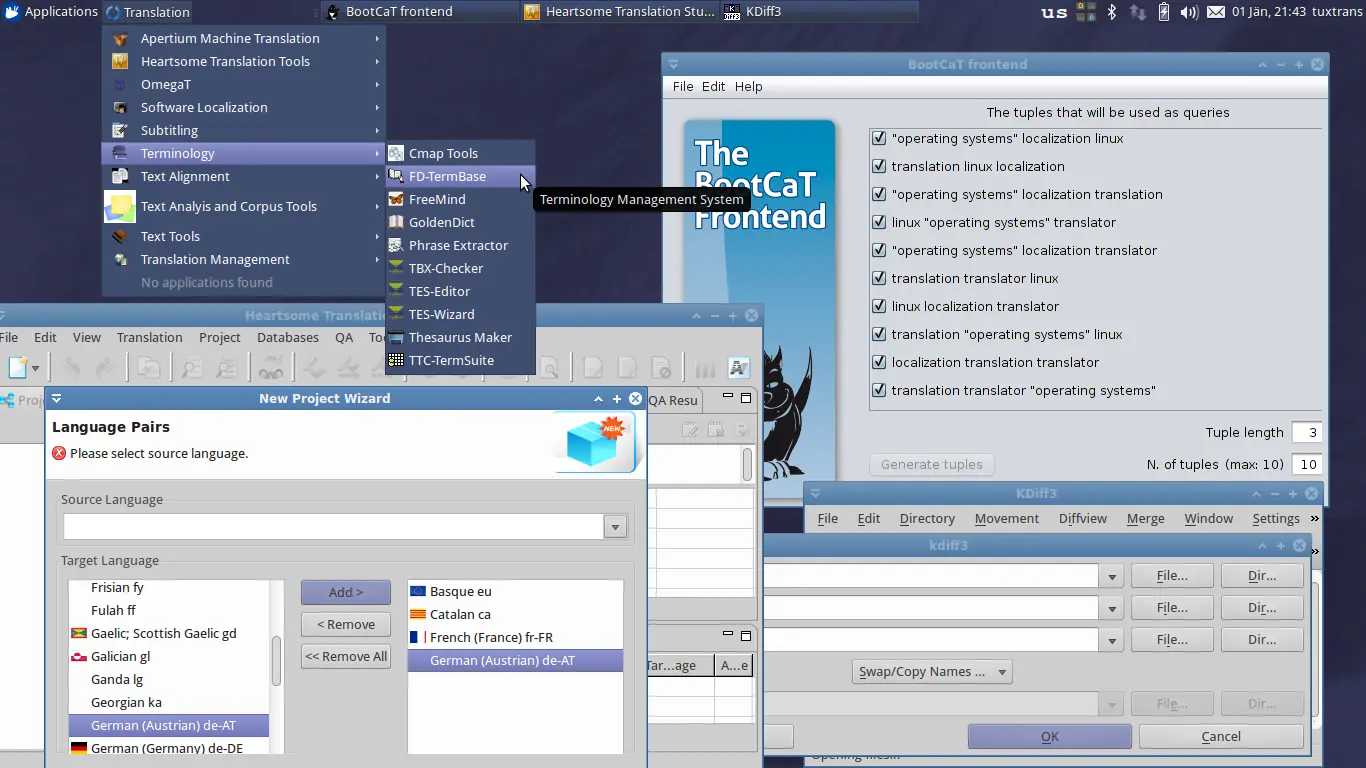
Todo lo que es y trae consigo:
System:
OS: Ubuntu 10.04.2 LTS
Java: Sun Java JRE
File Management: muCommander
CD/DVD burner: brasero
Windows compatibility: Wine
Password management: keepassx
Make USB bootable: Unetbootin
Editor:
gedit
JEdit
Web:
Web Browser: Firefox
Mail: Thunderbird
Web editor: Kompozer
VOIP: Skype
Website download: HTTrack, Scrapbook
Office:
Office package: LibreOffice.org
DTP: Scribus
Finances: GNUCash, GnoTime Tracker
Calendar: Mozilla Lightning
Project management: OpenProj
Reference management: Zotero, JabRef
PDF-Tools:
PDF-Toolkit (convert to other formats)
PDF-Chain (GUI for pdf toolkit)
PDFSam (extract and merge single pages)
gPDFText (convert to plain text)
Xournal (annotate pdf files)
Multimedia:
Graphics viewer: GThumb
Video: Totem Video Player
Translation:
Translation Memory:
OmegaT
Anaphraseus
Transolution XLIFF editor
Sun Open Language Tools
Alignment: BiText2TMX
Concordancer and text analysis:
AntConc
TextSTAT2
AdTAT
Terminology management
Terminology management system: ForeignDesk-TermBase
Term/phrase extraction: EXT32
Thesaurus building: TheW
Concept systems and hierarchies: CMap Lite
GoldenDict
Video subtitling:
Gaupol
Subtitle Editor
Software localization and conversion tools:
Virtaal
Translate toolkit
POEdit
Maxprograms
Okapi Localization Tools
Translate toolkit
Tuxtrans es el mejor OS que he visto nunca para aquellos que trabajamos como traductores profesionales. Evitando todos estos programas costosos y poco desarrollados, nos abrimos a un mundo en el que el open source nos facilita gratis absolutamente todas las posibilidades que el soft propietario nos vende a alto precio, y no contento con esto, nos regala utilidades pensadas por expertos traductores y desarrolladas según sus criterios, que el sof propietario no logra copiar.
El único problema es aprender a usarlo, pero poco a poco, en unos días se logra una completa interacción con el entorno y los resultados se dejan notar.
Os recomiendo problarlo.
"Why universities should use free software:
As a university teacher I am trying to use exclusively free software. There are a lot of arguments why a publicly funded university such as mine, the University of Innsbruck, should do so.
First of all there are the four essential freedoms as set up by the Free Software Foundation:
The freedom to run the program, for any purpose (freedom 0).
All members of the department, staff and students, may use the software for whatever purpose they wish: doing research, teaching in the classroom, doing assignments at home, etc.
The freedom to study how the program works, and change it to make it do what you wish (freedom 1).
At least we have the possibility to improve the software, although as a humanities department we usually do not have the necessary skills to do so. However, this could be part of research projects where some funds could be allocated to further develop the software or to integrate new features.
The freedom to redistribute copies so you can help your neighbor (freedom 2).
This means no more licensing troubles, no more setting up license servers nor installing dongles. Everybody can take the software home, install it on his/her notebook or even USB stick and take it everywhere. This means students have access to the software wherever they wish. They are free to give it to friends and discuss it.
The freedom to improve the program, and release your improvements (and modified versions in general) to the public, so that the whole community benefits (freedom 3).
Provided the necessary skills or financial funds, the software may be adapted to the use in an educational environment or in a university network.
Then there are special reasons for an educational environment to use free software which go deeper. We educate active and responsible human beings, we do not indoctrinate consumers. With proprietary software such as “Windows, they are legally forbidden from adapting the software to solve a particular problem, or from satisfying an intellectual curiosity by examining its source code. An education using the power of computers should be a means to freedom and empowerment, not an avenue for one corporation to instill its monopoly through indoctrination. Free software, on the other hand, gives children a route to empowerment, by encouraging them to explore and learn.” (from “Education – one case against windows7 out of 7″).
“A university’s job is not to ‘train a student so they can get a job’; a university’s job is to ‘train a student how to think’, how to gather data, evaluate data, create information and lead people. A university’s job is to do research to further the base of knowledge, so we can move forward, and to publish this research so that others can move forward also. Universities should be using Free Software to do this research and using Free Software as the basis of the research. The public should not have to pay twice or three times for the same research.” cited from Universities that do not use Free Software: Time for a boycott?
See also this article from Richard Stallman the founder of the Free Software Foundation on the reasons why free software is needed in schools: “Why schools should exclusively use free software”, or the mp3-podcast (in German) with good arguments in favor of free software in schools from the CEBIT2011: Wolf-Dieter Zimmermann – Freie Software in der Schule
This is why we set up our FLOSS software collections for translators as well as for translator’s training:
USBTrans which uses FLOSS on top of a commercial operating system
tuxtrans which is a completely free translation workstation"
Descargar de aquí:
Versión completa 1,3 GB
Versión essentials: 687 MB