Hiroshima, 64 años atras
El 6 de agosto, se cumplen 64 años desde que el bombardeo atómico de Hiroshima, Japón por los Estados Unidos al final de la Segunda Guerra Mundial. Dirigida por razones militares y por su terreno (plano para facilitar la evaluación de las consecuencias), Hiroshima era el hogar de aproximadamente 250.000 personas en el momento del bombardeo por Los EE.UU.
B-29 Superfortress bombardero "Enola Gay" despegó de la isla de palestinos muy temprano en la mañana del 6 de agosto, con 8.900 libras de uranio en clave bomba "Little Boy".
Casi 70.000 personas se cree que han sido asesinados de inmediato, posiblemente, con otros 70.000 supervivientes de la muerte y lesiones por exposición a la radiación de 1950.
navegando por internet me encontre con esto y me parecio que seria buena idea compartirlo con la comunidad de taringa las fotografias son impresionantes lamentablemente es un hecho historico condenable sin pensarlo dos veces esto es algo que nunca debemos alvidar espero que les guste mi post los comentarios de las fotografias son en ingles pero las fotografias hablan por si solas
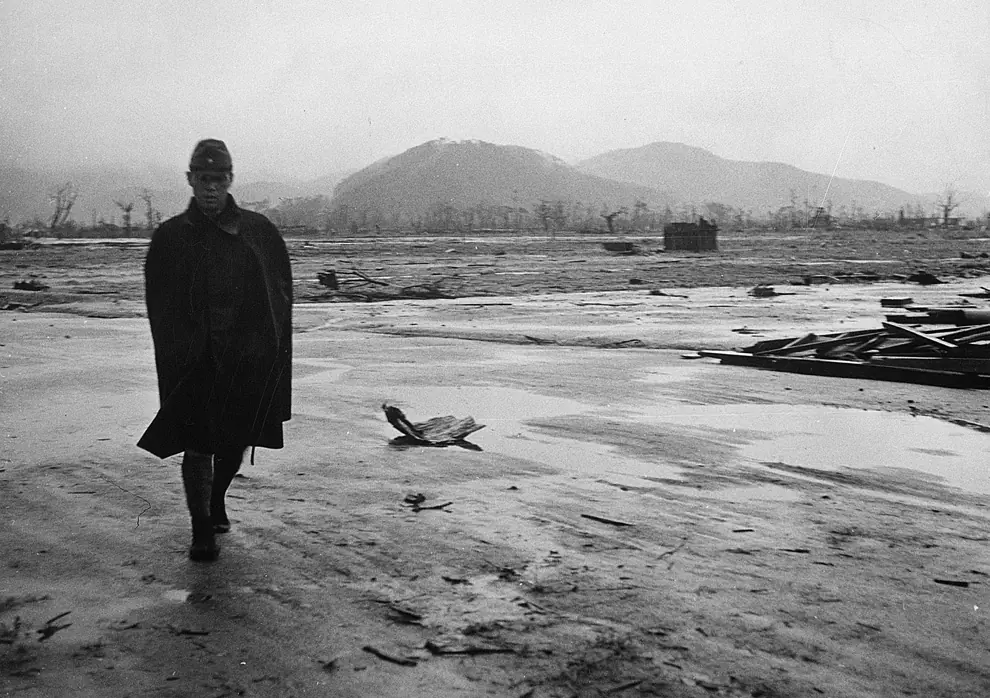
A Japanese soldier walks through a leveled area in Hiroshima, Japan in September of 1945, one month after the detonation of a nuclear bomb above the city. From a series of U.S. Navy photographs depicting the suffering and ruins that resulted from the blast. (U.S. Department of Navy)
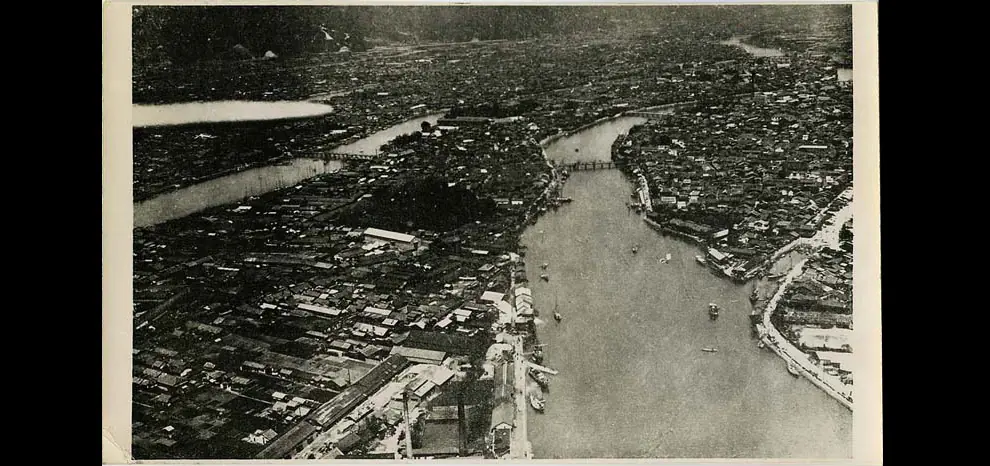
An aerial view of Hiroshima, viewed some time shortly before the bomb was dropped on it in August of 1945. The scene shows a very densely built-up area of the city on the Motoyasu River looking upstream. (Hiroshima: The United States Strategic Bombing Survey Archive, International Center of Photography, Purchase, with funds provided by the ICP Acquisitions Committee, 2006)
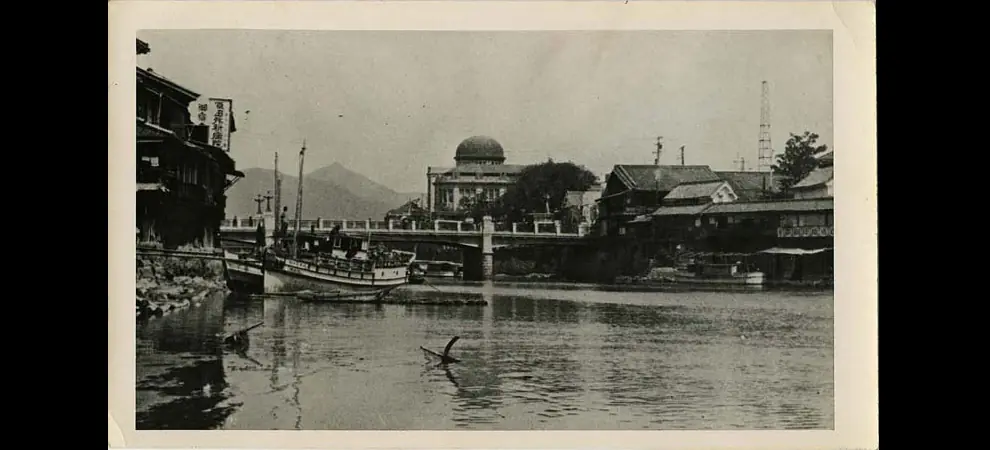
An early photograph of Hiroshima, before August 1945, looking upstream on the Motoyasu River toward what would become the most famous of all Hiroshima landmarks - the domed Hiroshima Prefectural Industrial Promotion Hall, immediately adjacent to ground zero. The building was originally designed by Czech architect Jan Letzel and completed in April 1915. (Hiroshima: The United States Strategic Bombing Survey Archive, International Center of Photography, Purchase, with funds provided by the ICP Acquisitions Committee, 2006)
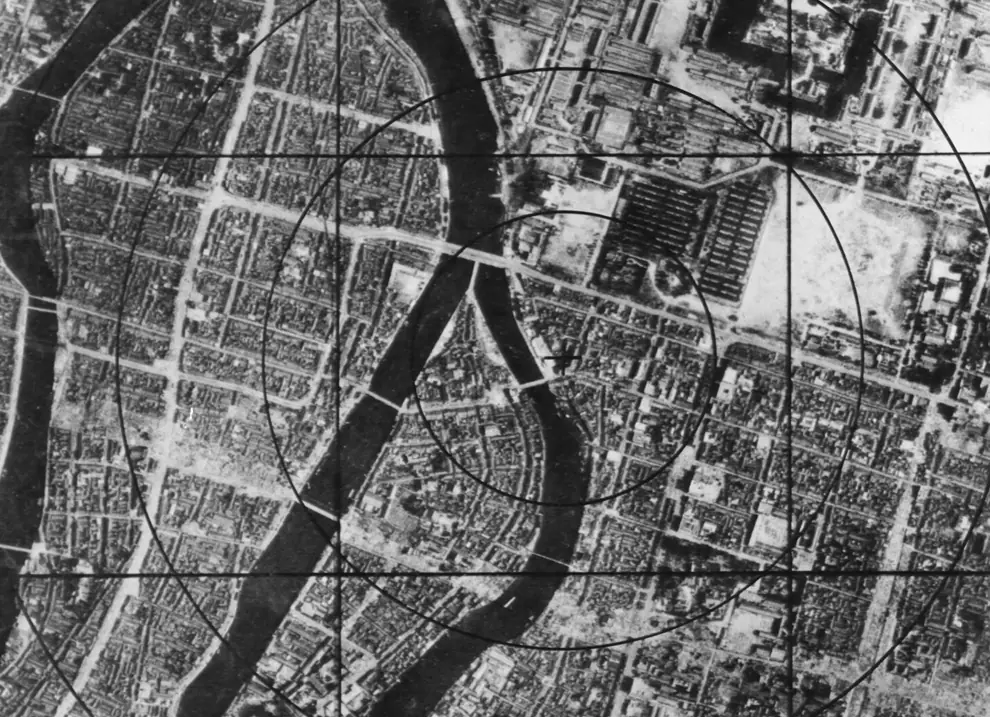
Detail from a U.S. Air Force map of Hiroshima, pre-bombing, circles drawn at 1,000 foot intervals radiating out from ground zero, the site directly under the explosion. (U.S. National Archives and Records Administration)
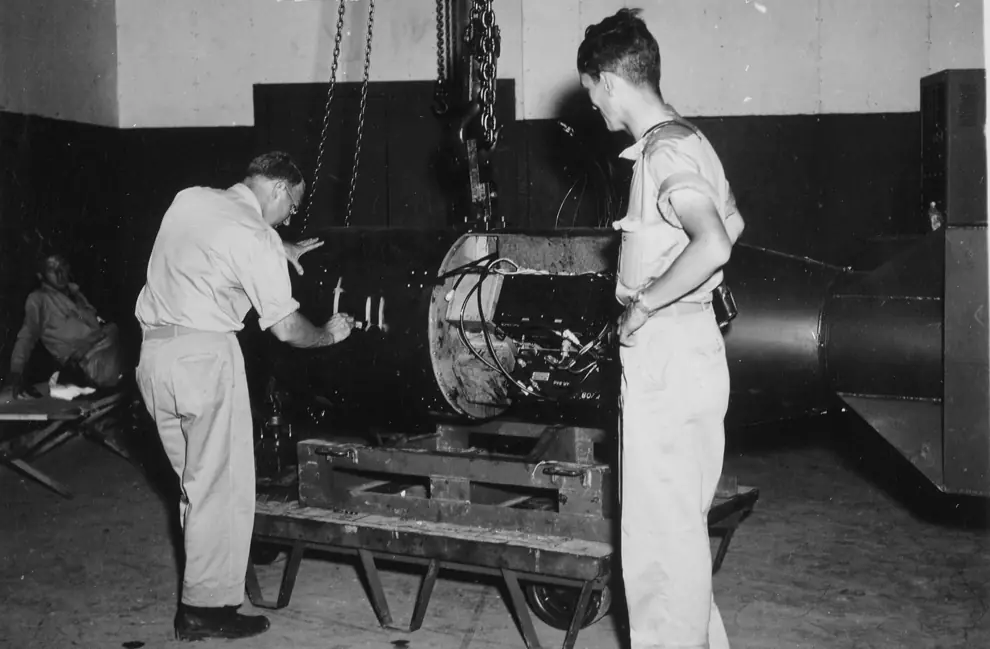
Commander A.F. Birch (left), shown numbering the bomb codenamed "Little Boy" unit L-11, before loading it on trailer in Assembly Bldg. #1, prior to it being loaded aboard the B-29 Superfortress bomber "Enola Gay", on the base of the 509th Composite Group at Tinian Island in the Marianas Islands in 1945. Physicist Dr. Norman Ramsey stands at right - he would later go on to win the Nobel Prize in Physics in 1989. (U.S. National Archives)
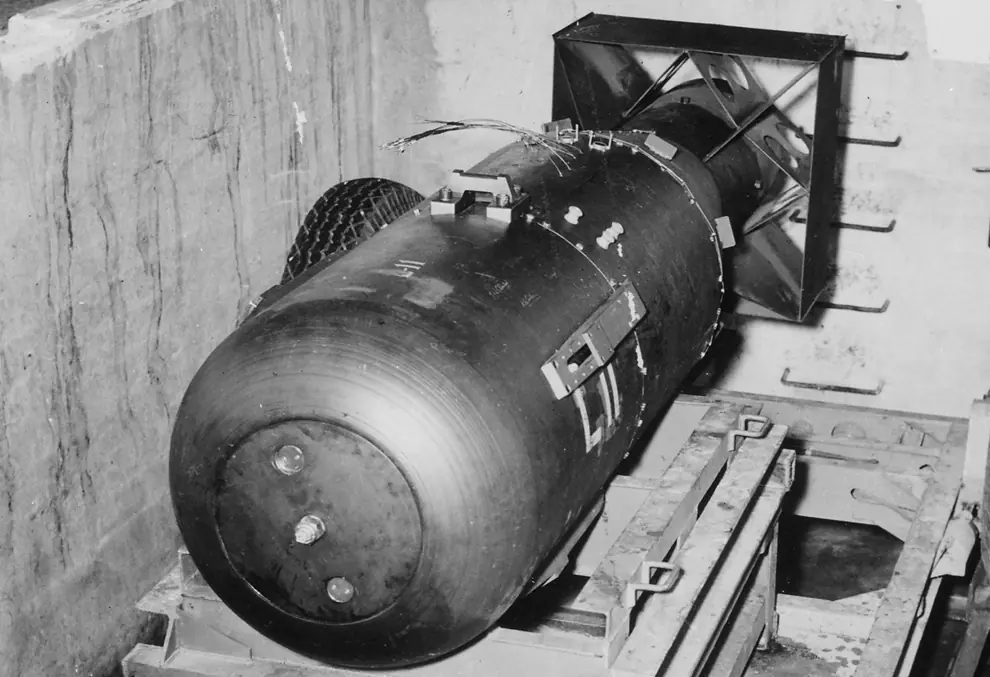
"Little Boy" unit rests on a trailer cradle in a pit below the open bomb bay doors of the B-29 Superfortress bomber "Enola Gay" on the 509th Composite Group base at Tinian Island in the Marianas Islands in 1945. Little Boy was 3 m (10 ft) long, and weighed 4,000 kg (8,900 lb), but only carried contained 64 kg (141 lbs) of uranium which would be used to create a nuclear chain reaction, and resulting explosion. (U.S. National Archives)
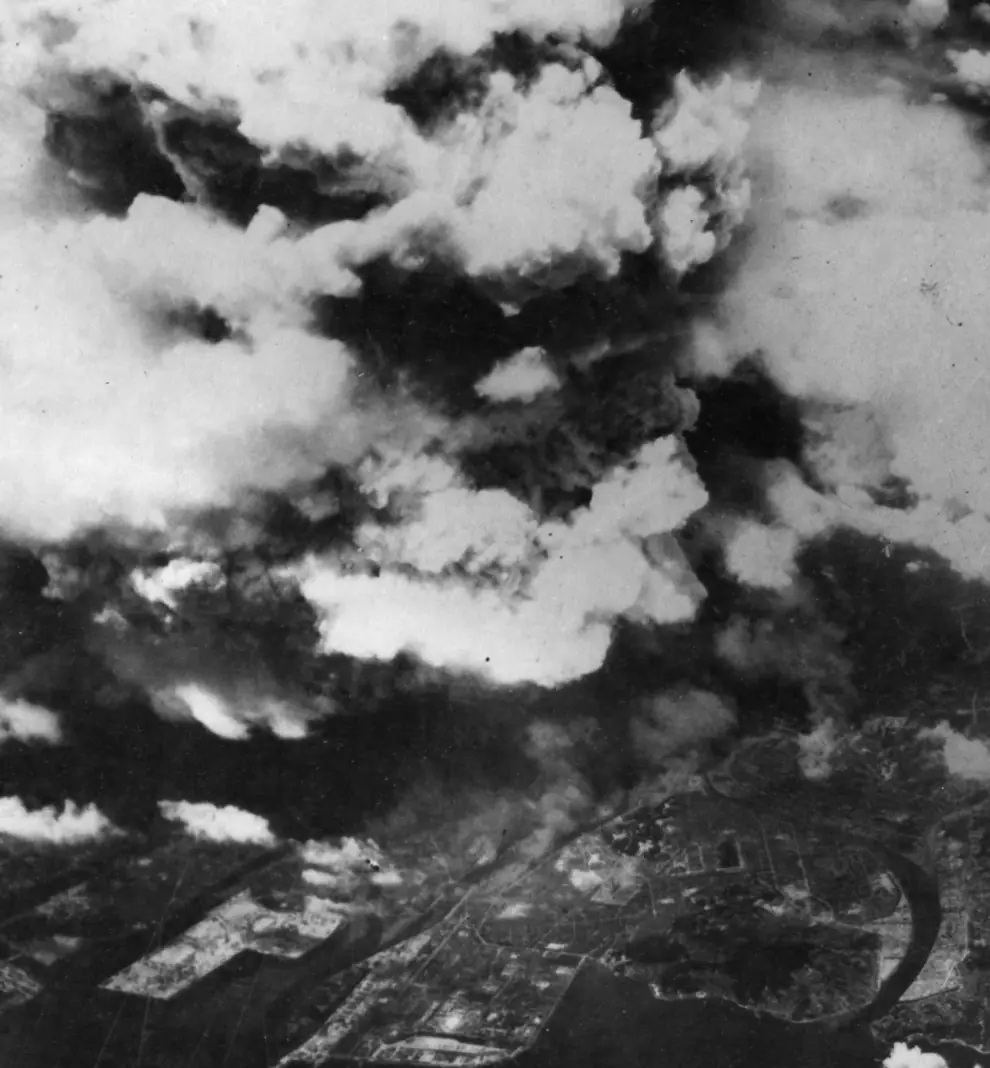
Shortly after 8:15 am, August 5, 1945, looking down on the rising smoke from the atomic explosion above the city of Hiroshima from one of two U.S. Air Force bombers from the 509th Composite Group. By the time this photo was taken, the flash of light and intense heat from a fireball 370 m (1,200 ft) diameter had already taken place, and an intense shockwave radiating out faster than the speed of sound was dissipating, having done most of its damage to ground structures and people in a circle 3.2 km (2 mi) in diameter. (U.S. National Archives)
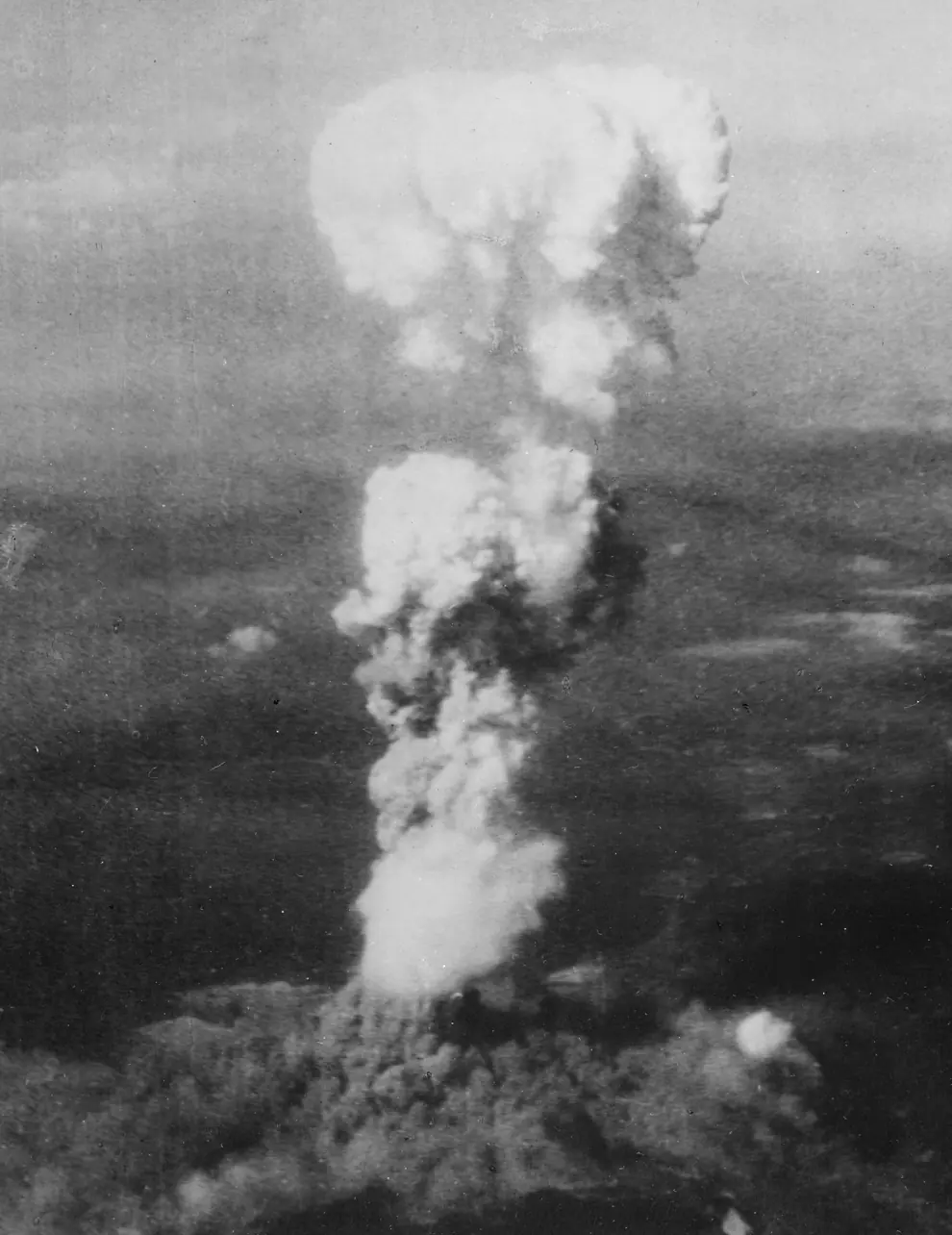
Shortly after 8:15 am, August 5, 1945, looking back at the growing "mushroom" cloud above Hiroshima. When a portion of the uranium in the bomb underwent fission, and was transformed instantly into an energy of about 15 kilotons of TNT (about 6.3 × 10¹³ joules), heating a massive fireball to a temperature of 3,980 C (7,200 F). The superheated air and smoke rapidly rose through the atmosphere like a giant bubble, dragging a column of smoke up with it. By the time this photo was made, smoke had billowed 20,000 feet above Hiroshima while smoke from the burst of the first atomic bomb had spread over 10,000 feet on the target at the base of the column. (U.S. National Archives)
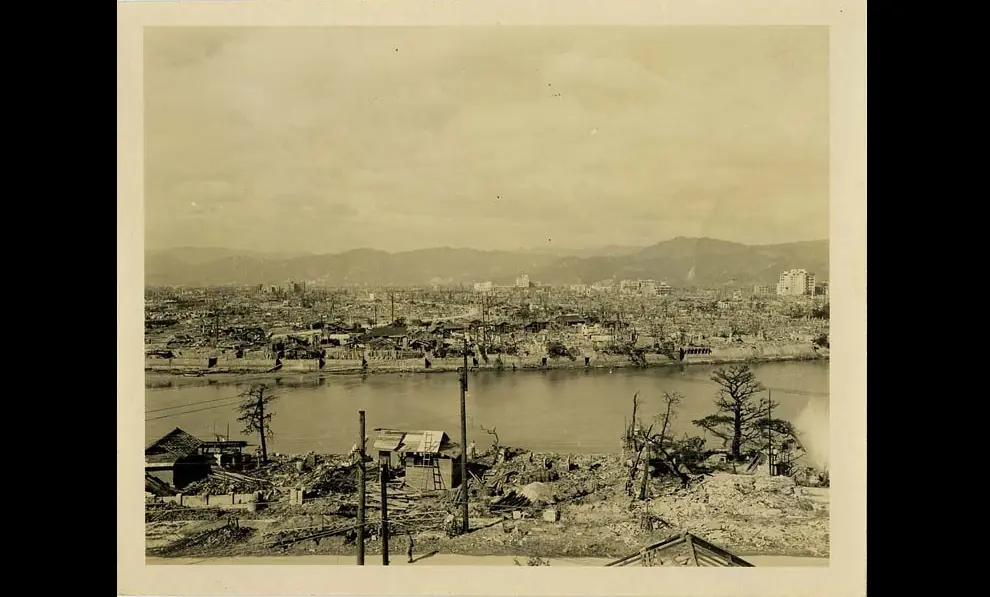
A view of destruction in Hiroshima, in the autumn of 1945, across one of the branches of the river that cut across the delta the city is centered on. (Hiroshima: The United States Strategic Bombing Survey Archive, International Center of Photography, Purchase, with funds provided by the ICP Acquisitions Committee, 2006)
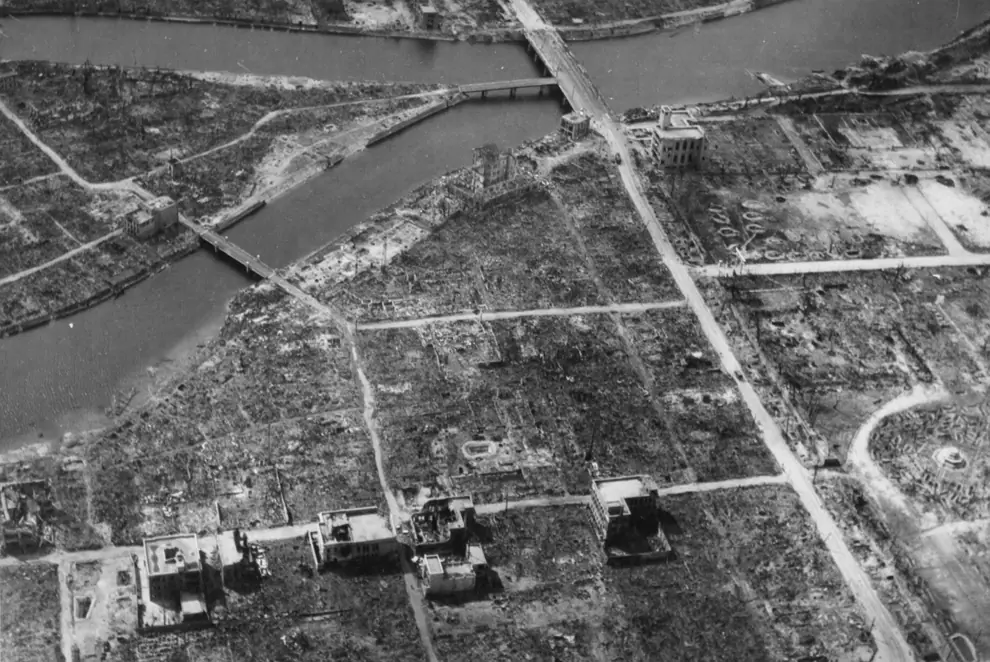
A View Of ground zero in Hiroshima in the autumn of 1945, showing total destruction resulting from dropping of the first atomic bomb. The hypocenter (point directly below the bomb explosion) is visible in this photograph, approximately above the Y-shaped intersection at center-left. (U.S. National Archives)
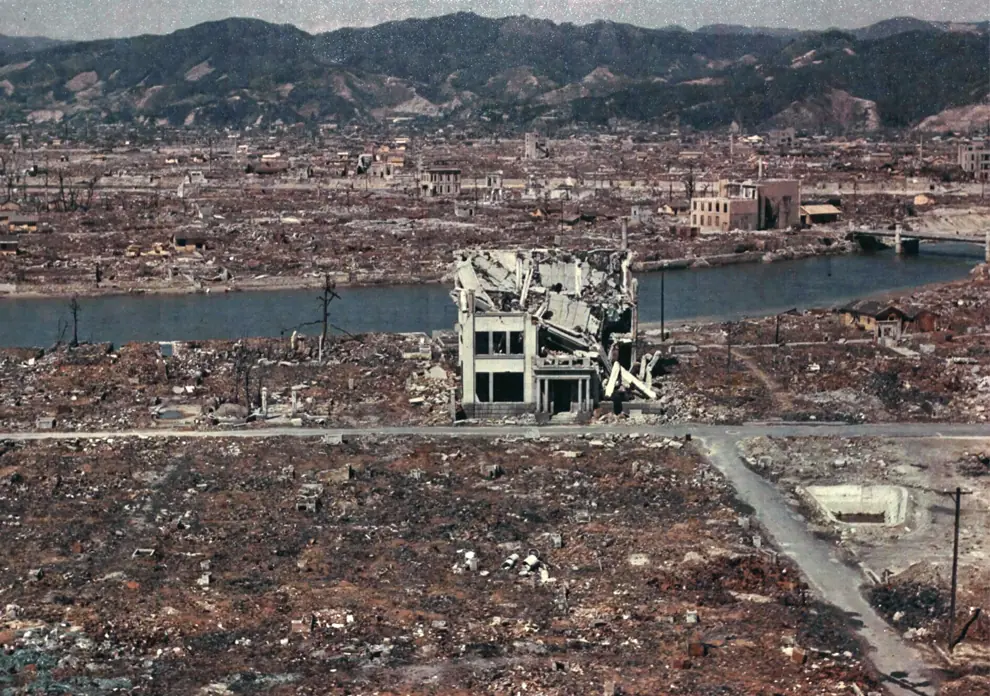
Color photograph showing damage in Hiroshima in March of 1946. (U.S. National Archives)
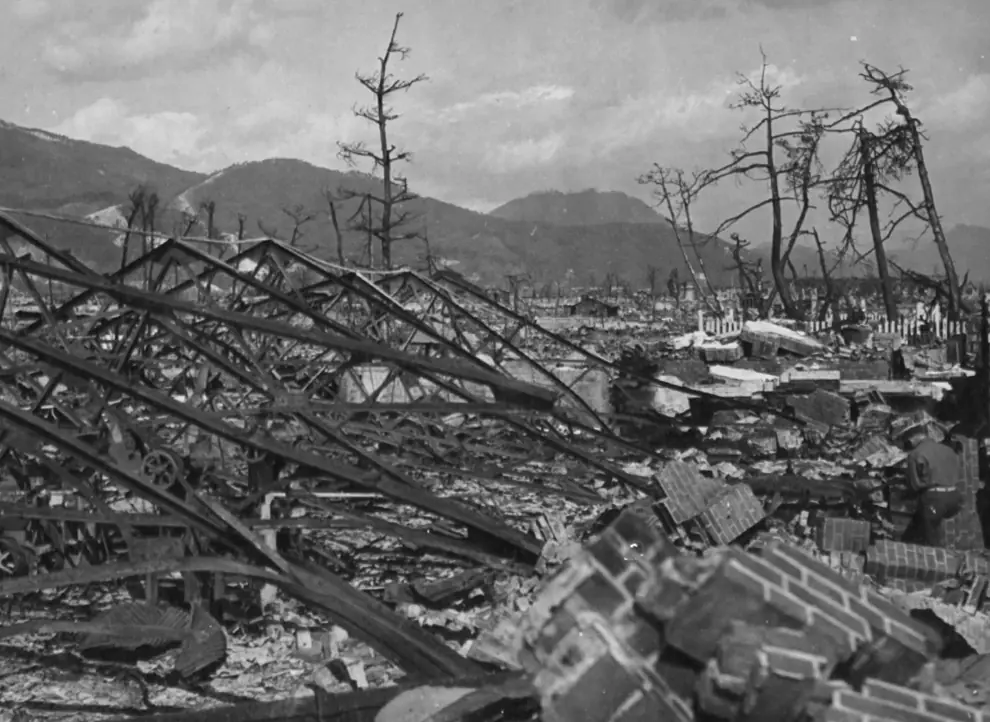
Bomb damage to Okita Iron Works, Hiroshima, Japan. November 7th, 1945. (U.S. National Archives)

A street scene showing atomic bomb damage in Hiroshima. Note how the sidewalk has been pushed up, and a drain pipe has punched through through the bridge. Scientists say this phenomenon is due to a vacuum created by pressure of the atomic blast. (U.S. National Archives)
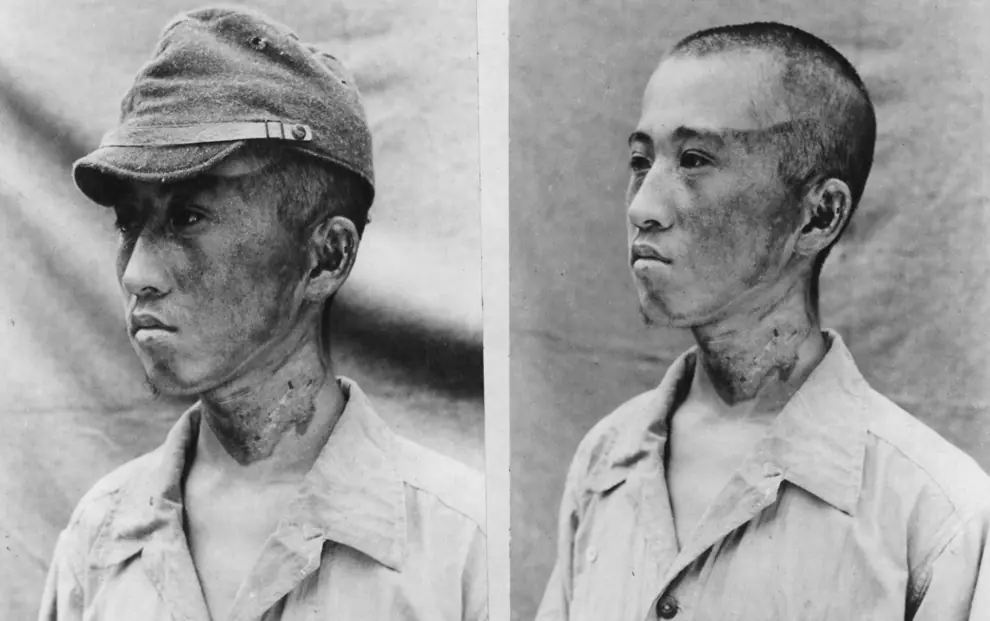
This patient (photographed by Japanese forces on October 2nd, 1945) was about 6,500 feet from ground zero when the rays struck him from the left. His cap was sufficient to protect the top of his head against flash burns. (U.S. National Archives)
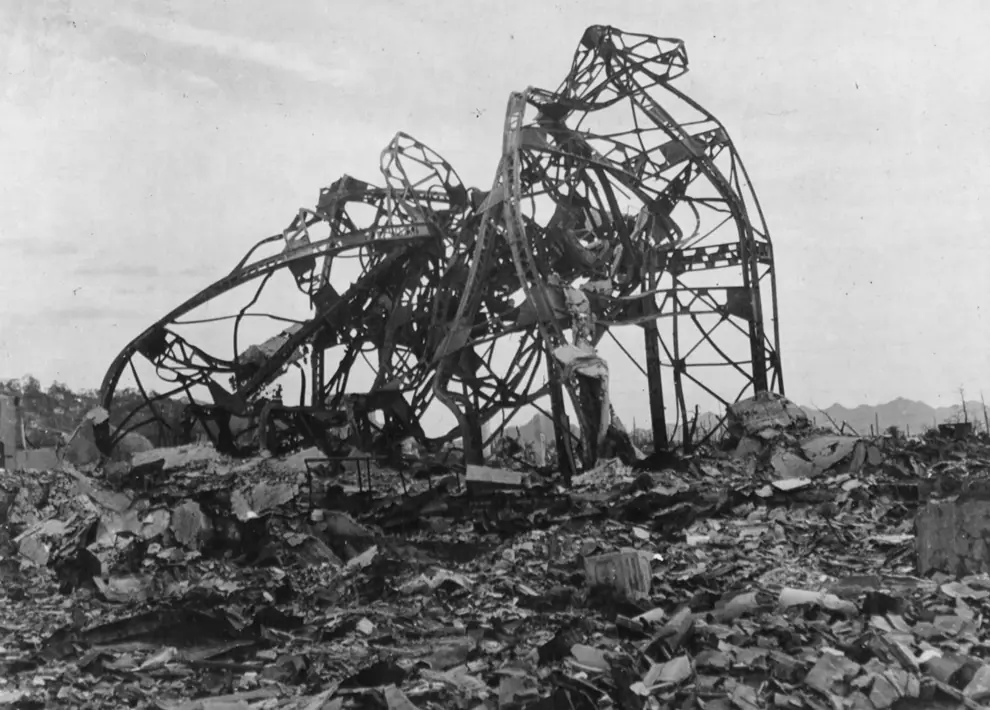
Twisted iron girders are all that remain of this theatre building located about 800 meters from ground zero. (U.S. National Archives)
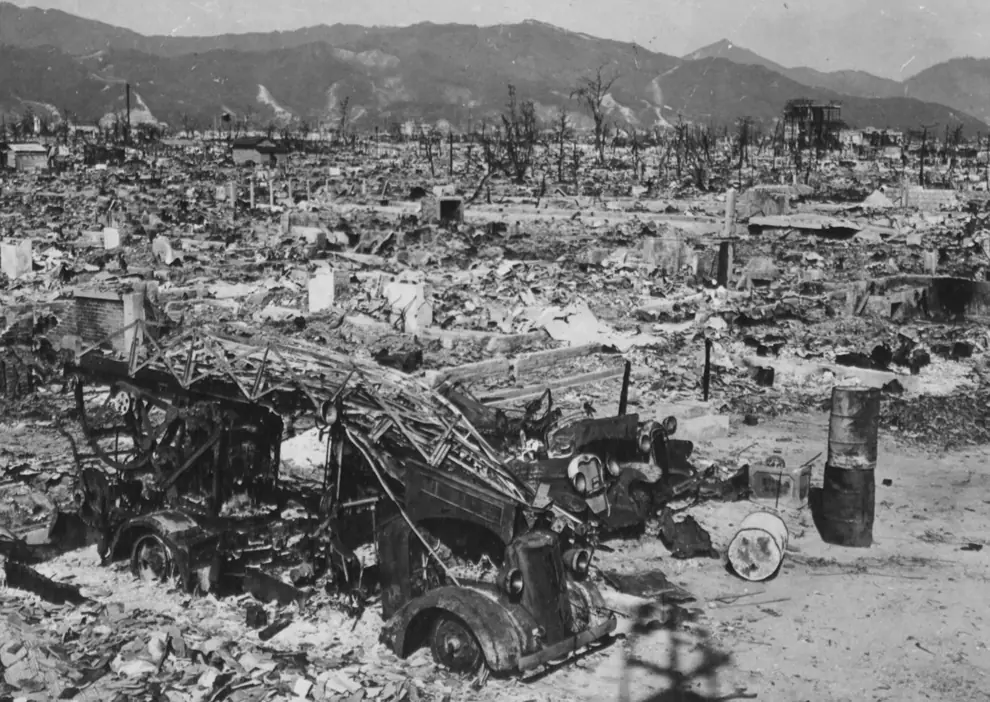
The Hiroshima Fire Department lost its only ladder truck when its West Side main fire station was destroyed by the blast and fire of the atomic bomb, 1,200 m (4,000 ft) from ground zero. (U.S. National Archives)
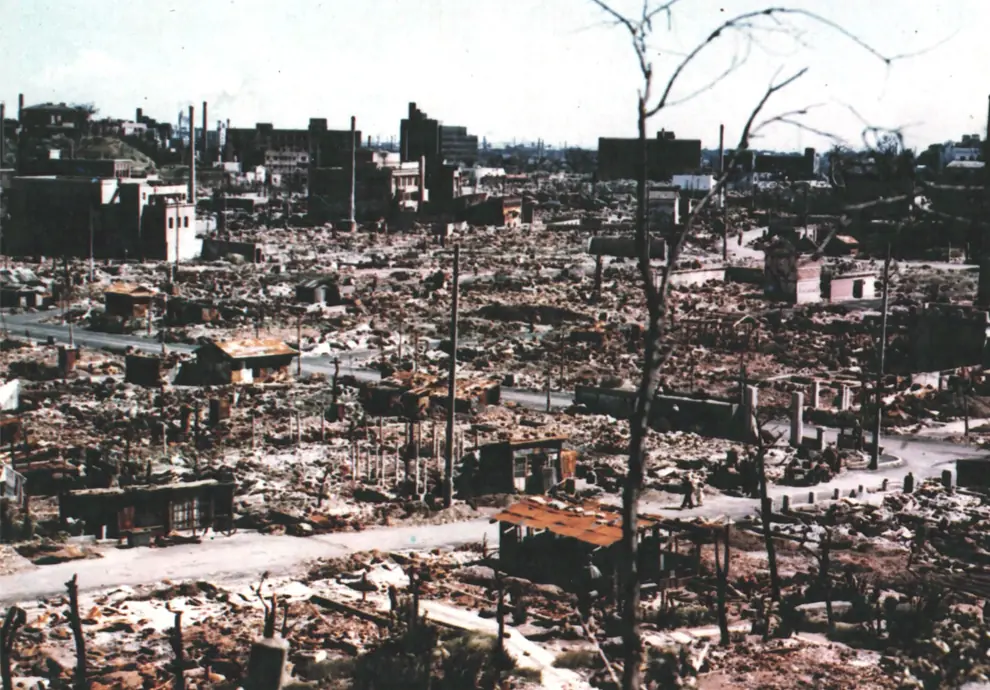
Color photograph of the ruins of central Hiroshima in autumn of 1945. (U.S. National Archives)
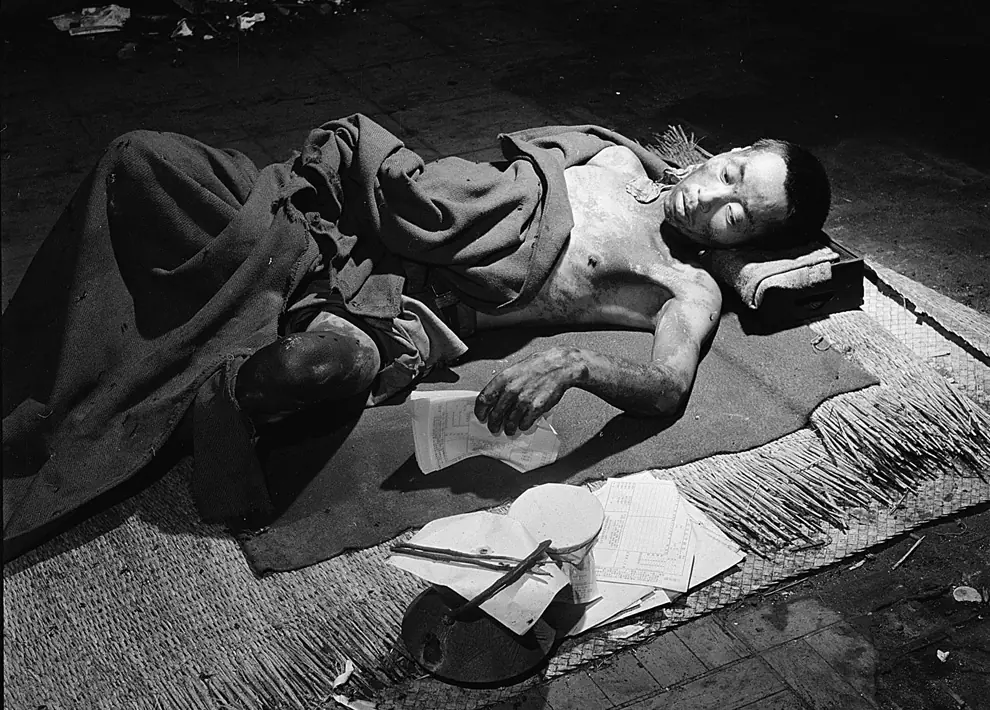
A victim of the bombing in Hiroshima lies in a makeshift hospital located in one of the remaining in bank buildings in September of 1945. (U.S. Department of Navy)
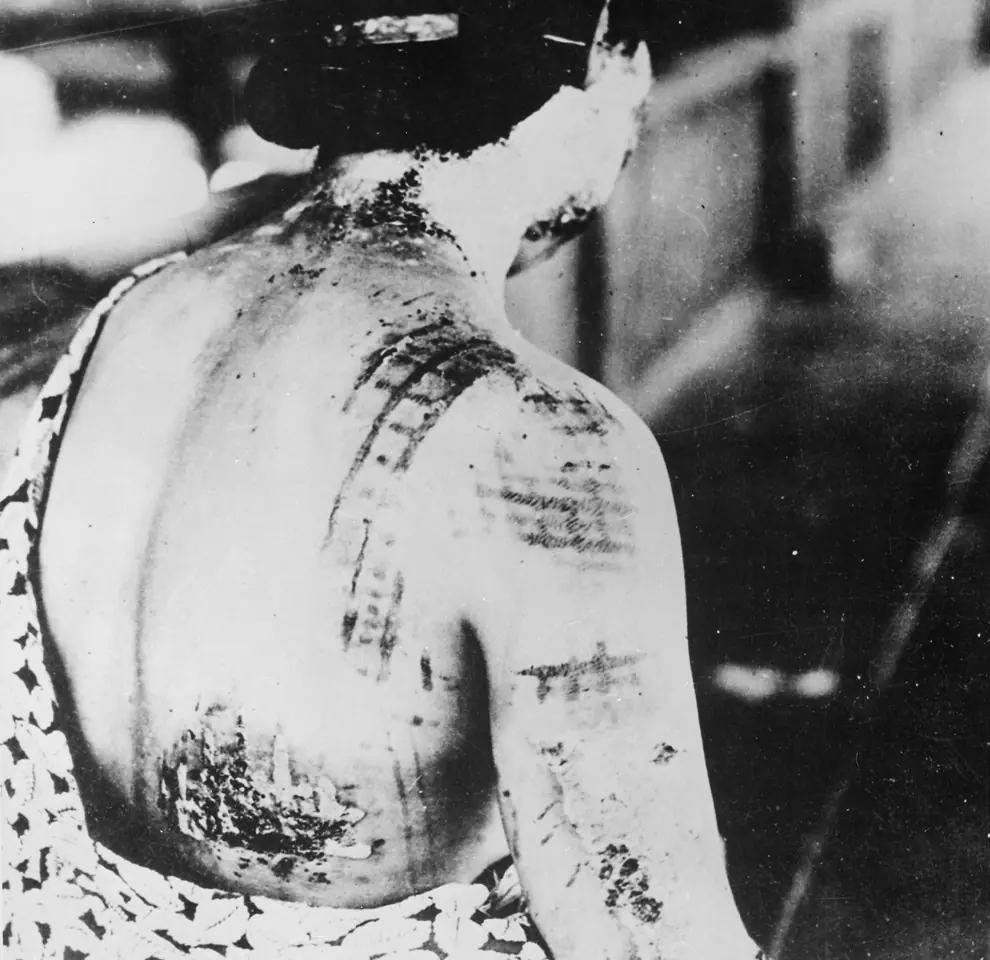
From the caption provided with this photo of a victim from Hiroshima: "The patient's skin is burned in a pattern corresponding to the dark portions of a kimono worn at the time of the explosion". (U.S. National Archives)
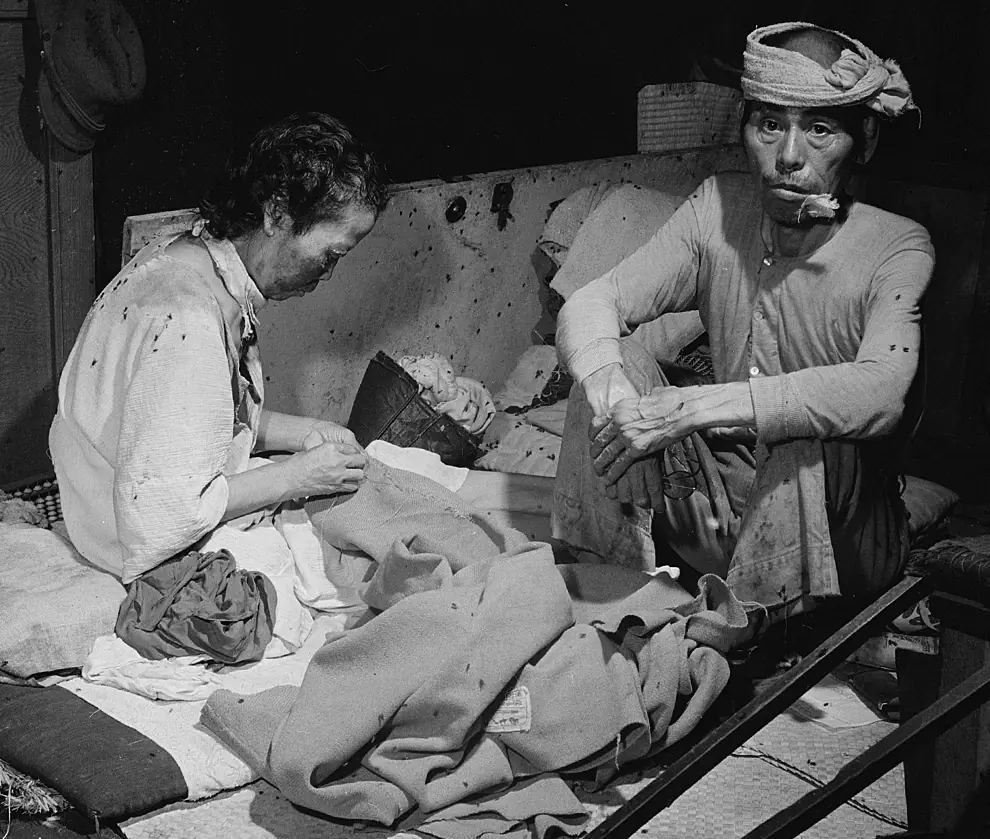
Blast victims shown in a fly-infested makeshift hospital in a bank building in Hiroshima on September 15th, 1945. (U.S. Department of Navy)
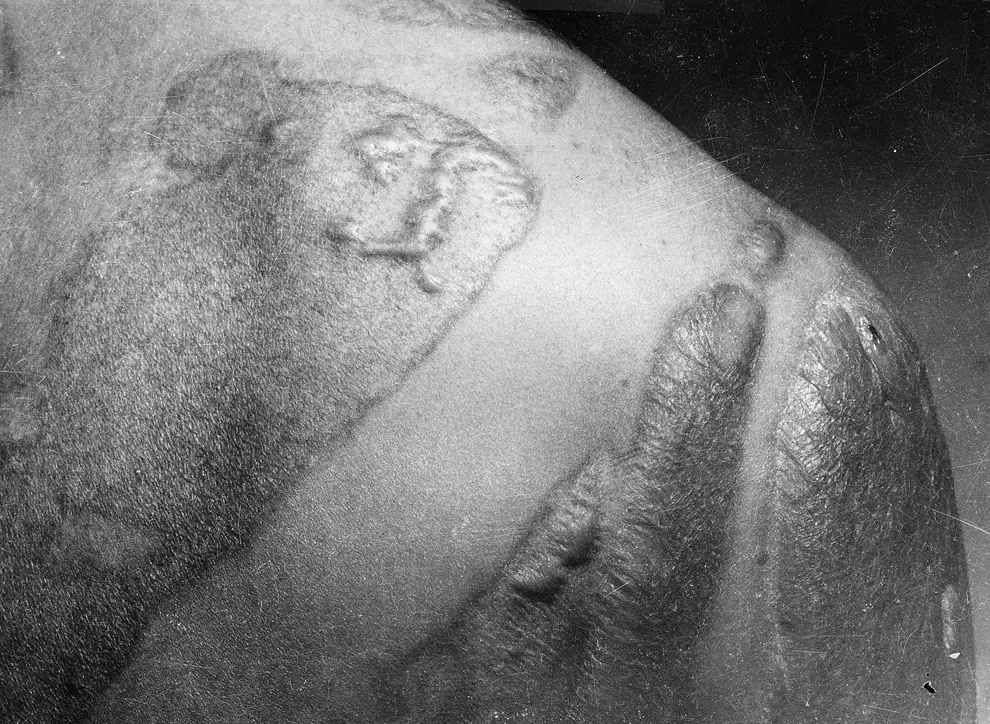
Formation of keloidal scars on the back and shoulder of a victim of the Hiroshima blast. The scars have formed where the victim's skin was directly exposed to the heat of the explosion's initial flash. (U.S. National Archives)
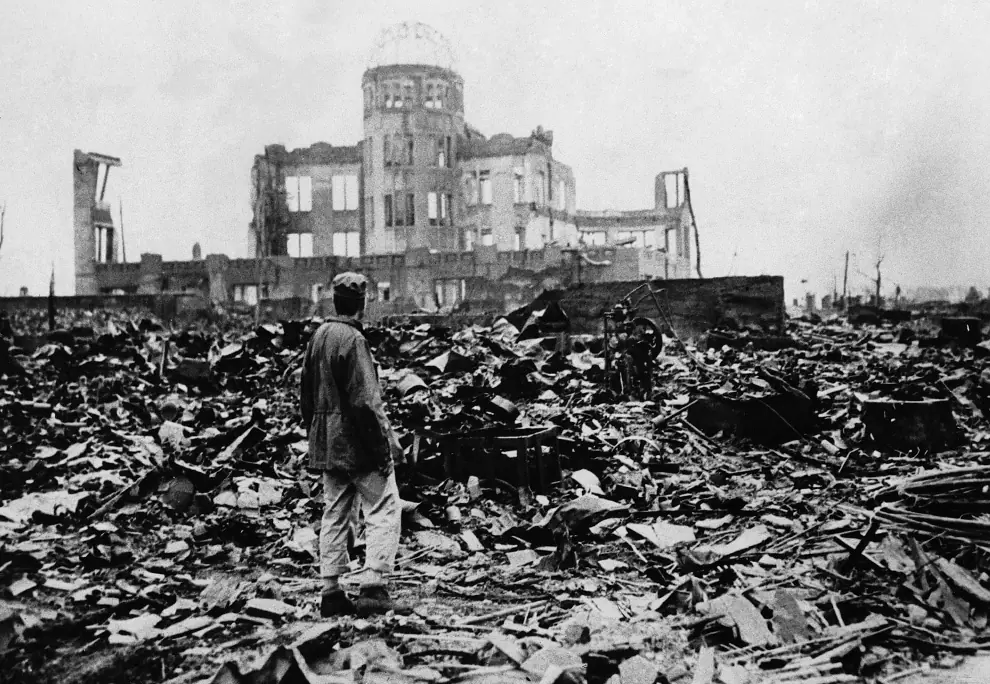
A man looks over the expanse of ruins left by the explosion of the atomic bomb on in Hiroshima, Japan. (AP Photo)
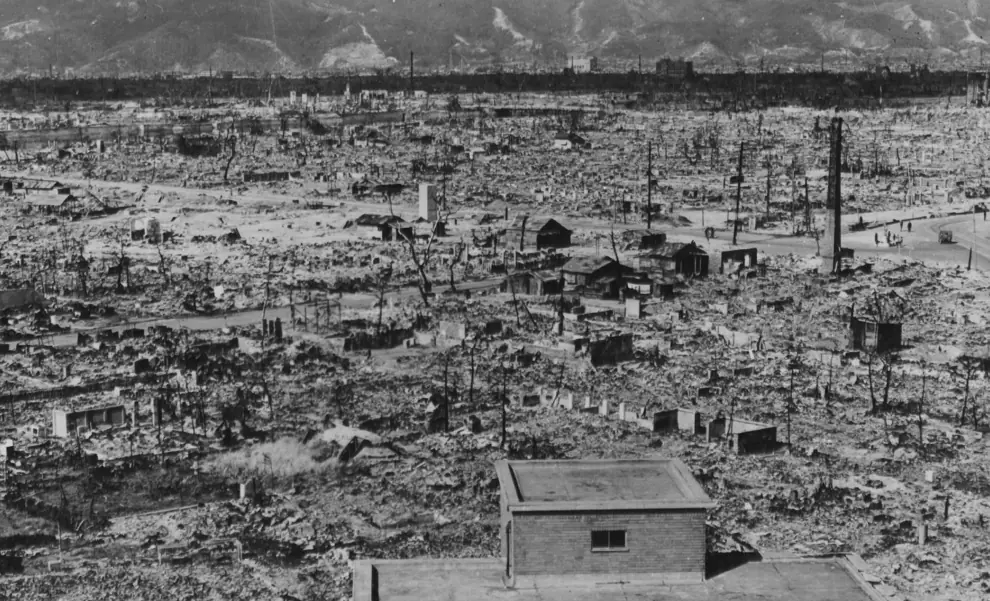
A view of Hiroshima and outlying hills, seen in the autumn of 1945, from from the ruins of the Red Cross building, less than one mile from the hypocenter. (U.S. National Archives)
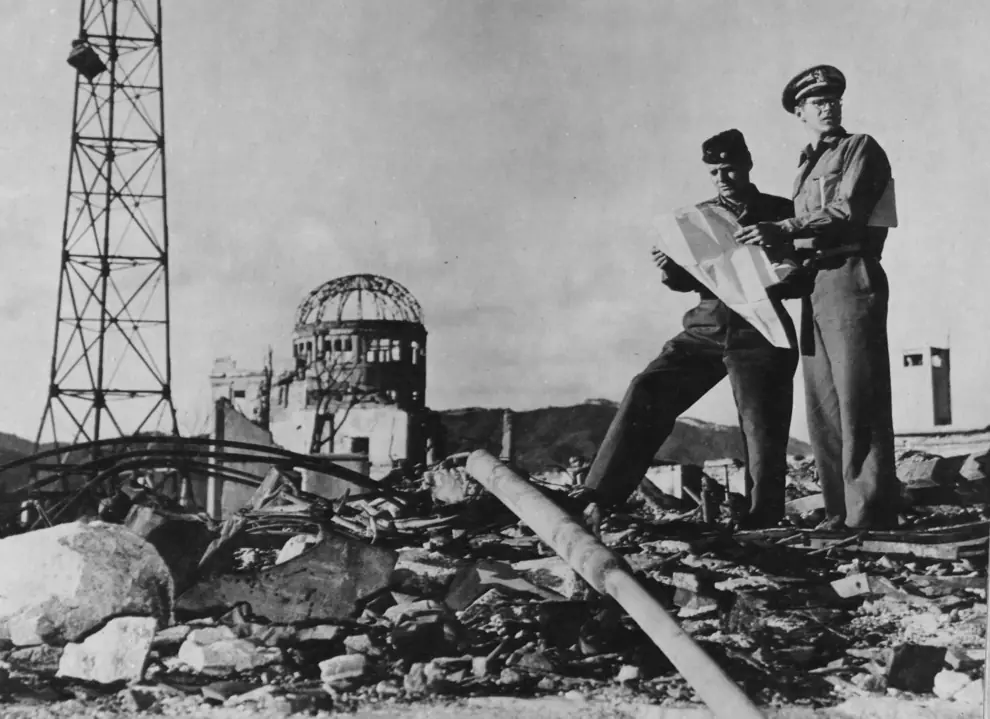
Members of the U.S. Army examine the area around ground zero in Hiroshima, Japan in the autumn of 1945. (U.S. National Archives)
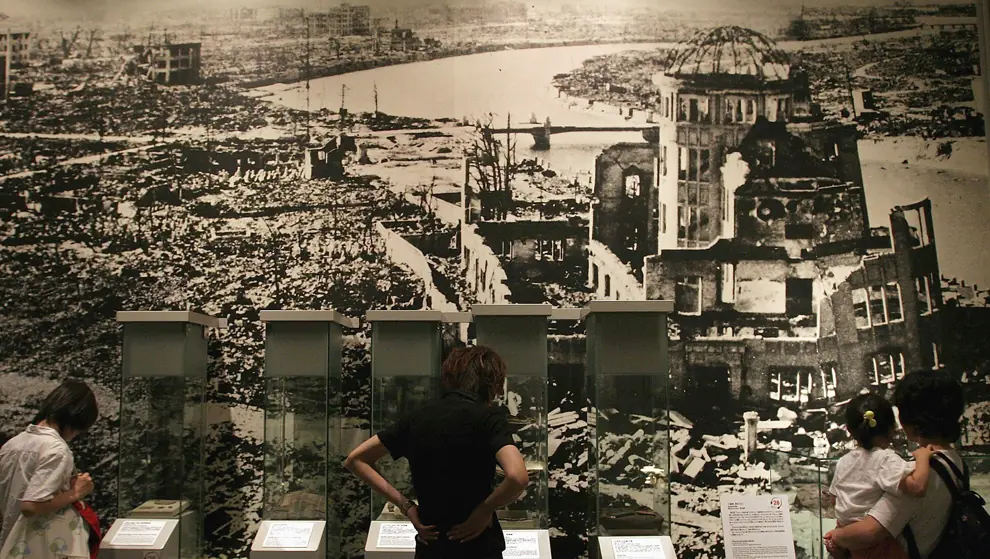
Visitors view a panorama showing the aftermath of the atomic bomb attack, at a museum at the Hiroshima Peace Memorial Park on July 27, 2005 in Hiroshima. Japan. (Photo by Junko Kimura/Getty Images)
GRACIAS TARINGA POR SU ATENCION