Extraterrestrial hypothesis
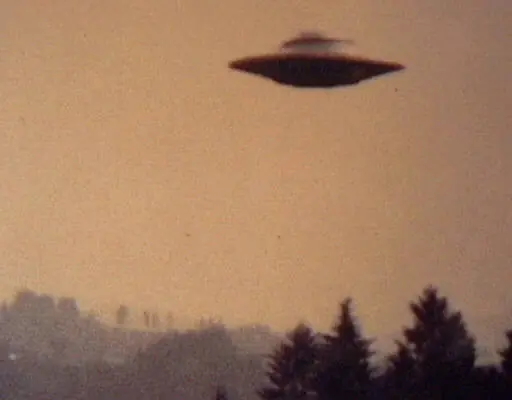
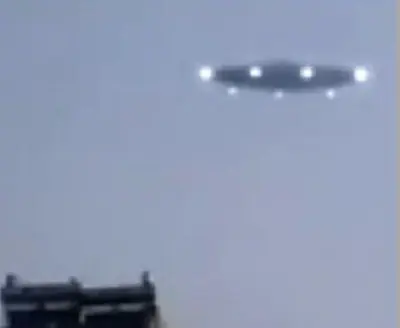
While technically a UFO refers to any unidentified flying object, in modern popular culture the term UFO has generally become synonymous with alien spacecraft. Proponents argue that because these objects appear to be technological and not natural phenomenon, and are alleged to display flight characteristics or have shapes seemingly unknown to conventional technology, the conclusion is then that they must not be from Earth.
 [2][3][4] Though UFO sightings have occurred throughout recorded history, modern interest in them dates from World War II (see foo fighter), further fueled in the late 1940s by Kenneth Arnold's coining of the term flying saucer and the Roswell UFO Incident. Since then governments have investigated UFO reports, often from a military perspective- and UFO researchers have investigated, written about, and created organizations devoted to the subject. One such investigation, The UK's Project Condign report, notes that Russian, Former Soviet Republics, and Chinese authorities have made a co-ordinated effort to understand the UFO topic and that State military organizations, particularly in Russia, have done "considerably more work (than is evident from open sources)" on military applications which have stemmed from their UFO research. The report also noted that "several aircraft have been destroyed and at least four pilots have been killed 'chasing UFOs'."[5]
Studies
Studies have established that the majority of UFO observations are misidentified conventional objects or natural phenomenon— most commonly aircraft, balloons, noctilucent clouds, nacreous clouds, or astronomical objects such as meteors or bright planets with a small percentage even being hoaxes.[6] After excluding incorrect reports, however, it is acknowledged that between 5% and 20% of reported sightings remain unexplained, and as such can be classified as unidentified in the strictest sense. Many reports have been made by trained observers such as pilots, police, and the military; some involve radar traces, so not all reports are visual.[7] Proponents of the extraterrestrial hypothesis believe that these unidentified reports are of alien spacecraft, though various other hypotheses have been proposed.
While UFOs have been the subject of extensive investigation by various governments, and some scientists support the extraterrestrial hypothesis, few scientific papers about UFOs have been published in peer-reviewed journals.[8] There has been some debate in the scientific community about whether any scientific investigation into UFO sightings is warranted.[9][10][11][12][13][14][15]
The void left by the lack of institutional scientific study has given rise to independent researchers and groups, most notably MUFON (Mutual UFO Network) [16] and CUFOS (Center for UFO Studies).[17] The term "Ufology" is used to describe the collective efforts of those who study reports and associated evidence of unidentified flying objects. According to MUFON, as of 2011 the number of UFO reports to their worldwide offices has increased by 67% from the previous 3 years, which now average around 500 reported sightings per month.[18]
UFOs have become a relevant theme in modern culture,[19] and the social phenomena have been the subject of academic research in sociology and psychology.[8]
Terminology
The first publicized sightings were usually referred to using the term mystery airships, which were commonly seen and described as such during the latter part of the 19th century and the early 20th.[20]
The term foo fighters was used by American fighter pilots during World War II to refer to UFOs.
The first widely publicized U.S. sighting, reported by private pilot Kenneth Arnold in June 1947, gave rise to the popular terms "flying saucer" and "flying disc", of which the former is still sometimes used, even though Arnold said the most of the objects he saw were not totally circular and one was crescent-shaped (see Kenneth Arnold UFO sighting for details). In addition, the infamous Roswell UFO Incident occurred at about the same time, which only served to further fuel public interest in the topic.
The term "UFO" was first suggested in 1952 by Cpt. Edward J. Ruppelt, who headed Project Blue Book, then the USAF's official investigation of UFOs. Ruppelt felt that "flying saucer" did not reflect the diversity of the sightings. He suggested that UFO should be pronounced as a word – you-foe. However it is now usually pronounced by forming each letter: U.F.O. His term was quickly adopted by the United States Air Force, which also briefly used "UFOB". The Air Force initially defined UFOs as those objects that remain unidentified after scrutiny by expert investigators,[21] though today the term UFO is often used for any unexplained sighting regardless of whether it has been investigated.
Because the term UFO is ambiguous – referring either to any unidentified sighting, or in popular usage to alien spacecraft – and the public and media ridicule sometimes associated with the topic, some investigators now prefer to use other terms such as unidentified aerial phenomenon (or UAP).[22]
The equivalent acronym for UFO in Spanish, Portuguese, French, and Italian is OVNI (Objeto Volador No Identificado, Objeto Voador Não Identificado, Objet volant non identifié or Oggetto Volante Non Identificato).
Early history
Unexplained aerial observations have been reported throughout history. Some were undoubtedly astronomical in nature: comets, bright meteors, one or more of the five planets that can be seen with the naked eye, planetary conjunctions, or atmospheric optical phenomena such as parhelia and lenticular clouds. An example is Halley's Comet, which was recorded first by Chinese astronomers in 240 B.C. and possibly as early as 467 B.C. Such sightings throughout history were often treated as supernatural portents, angels, or other religious omens. Some current-day UFO researchers have noticed similarities between some religious symbols in medieval paintings and UFO reports[23] though the canonical and symbolic character of such images is documented by art historians placing more conventional religious interpretations on such images.[24]
Shen Kuo (1031–1095), a Song Chinese government scholar-official and prolific polymath inventor and scholar, wrote a vivid passage in his Dream Pool Essays (1088) about an unidentified flying object. He recorded the testimony of eyewitnesses in 11th-century Anhui and Jiangsu (especially in the city of Yangzhou), who stated that a flying object with opening doors would shine a blinding light from its interior (from an object shaped like a pearl) that would cast shadows from trees for ten miles in radius, and was able to take off at tremendous speeds.[25]
On January 25, 1878, The Denison Daily News wrote that local farmer John Martin had reported seeing a large, dark, circular flying object resembling a balloon flying "at wonderful speed." Martin also said it appeared to be about the size of a saucer, the first known use of the word "saucer" in association with a UFO.[26]
On February 28, 1904, there was a sighting by three crew members on the USS Supply 300 miles west of San Francisco, reported by Lt. Frank Schofield, later to become Commander-in-Chief of the Pacific Battle Fleet. Schofield wrote of three bright red egg-shaped and circular objects flying in echelon formation that approached beneath the cloud layer, then changed course and "soared" above the clouds, departing directly away from the earth after two to three minutes. The largest had an apparent size of about six suns.[27]
1916 and 1926: The three oldest known pilot UFO sightings, of 1305 cataloged by NARCAP. On January 31, 1916, a UK pilot near Rochford reported a row of lights, like lighted windows on a railway carriage, that rose and disappeared. In January 1926, a pilot reported six "flying manhole covers" between Wichita, Kansas and Colorado Springs, Colorado. In late September 1926, an airmail pilot over Nevada was forced to land by a huge, wingless cylindrical object.[28]
On August 5, 1926, while traveling in the Humboldt Mountains of Tibet's Kokonor region, Nicholas Roerich reported that members of his expedition saw "something big and shiny reflecting the sun, like a huge oval moving at great speed. Crossing our camp the thing changed in its direction from south to southwest. And we saw how it disappeared in the intense blue sky. We even had time to take our field glasses and saw quite distinctly an oval form with shiny surface, one side of which was brilliant from the sun.”[29] Another description by Roerich was, "...A shiny body flying from north to south. Field glasses are at hand. It is a huge body. One side glows in the sun. It is oval in shape. Then it somehow turns in another direction and disappears in the southwest."[30]
In the Pacific and European theatres during World War II, "Foo-fighters" (metallic spheres, balls of light and other shapes that followed aircraft) were reported and on occasion photographed by Allied and Axis pilots. Some proposed Allied explanations at the time included St. Elmo's Fire, the planet Venus, hallucinations from oxygen deprivation, or German secret weapons.[31][32]
On February 25, 1942, U.S. Army observers reported unidentified aircraft both visually and on radar over the Los Angeles, California region. Antiaircraft artillery was fired at what was presumed to be Japanese planes. No readily apparent explanation was offered, though some officials dismissed the reports of aircraft as being triggered by anxieties over expected Japanese air attacks on California. However, Army Chief of Staff Gen. George C. Marshall and Secretary of War Henry Stimson insisted real aircraft were involved. The incident later became known as the Battle of Los Angeles, or the West coast air raid.
In 1946, there were over 2000 reports, collected primarily by the Swedish military, of unidentified aerial objects in the Scandinavian nations, along with isolated reports from France, Portugal, Italy and Greece, then referred to as "Russian hail", and later as "ghost rockets", because it was thought that these mysterious objects were possibly Russian tests of captured German V1 or V2 rockets. Although most were thought to be natural phenomena like meteors, over 200 were tracked on radar and deemed to be "real physical objects" by the Swedish military. In a 1948 top secret document, the Swedish military told the USAF Europe in 1948 that some of their investigators believed them to be extraterrestrial in origin